What a child's eyes can tell us.
Many children - especially those who mask - can't always tell you when they're struggling. But the way they engage with a lesson can. Decades of research prove that eye movements are reliable, powerful signals of how a child is processing information.
PupilPower translates these hidden signals into real-time insights. We read these cues responsibly, turning data into clear evidence that empowers teachers to see past the mask and act sooner.
We're early, and we say so.
The platform is built and the concept is proven. The first module is in development, and we're validating it with clinical and academic partners now.
Some children are overlooked entirely.
Masking - hiding traits to appear to be coping - is especially common in girls, who research suggests camouflage more than boys.
Because autism's diagnostic criteria were largely developed from studies of boys, girls are recognised later, or not at all. Objective, classroom-based evidence helps surface the children a subjective system overlooks.
of autistic girls remain undiagnosed at age 18.
McCrossin, R. (2022), Children.
Grounded in published science.
More than 20 peer-reviewed studies link eye-movement patterns - saccades, fixations, gaze and pupil dynamics - to neurodivergence and cognitive load in children. This is the foundation we build on.
The perfect lab.
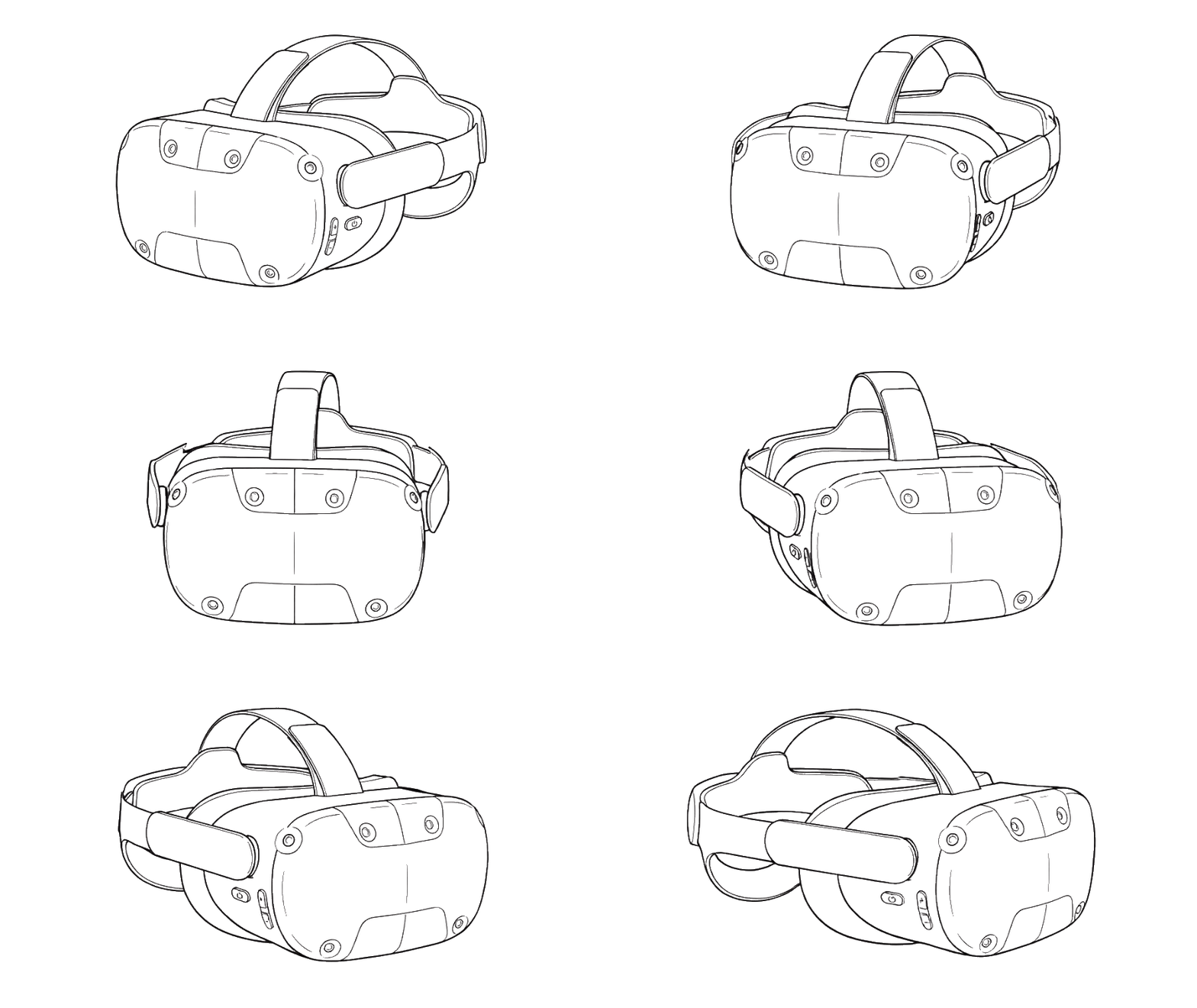
A VR lesson gives us something no other classroom tool can: a controlled, repeatable environment where every child meets the same stimuli.
And because children find it genuinely engaging, the data is cleaner - a stressed child produces noise; an engaged child produces signal.
From validated science to classroom-scale evidence.
The science is established. What hasn't existed is a way to apply it at scale, during normal lessons, and to track it over time.
That's what we're building: objective indicators of engagement and cognitive difficulty, captured termly, that form a longitudinal picture of how a child learns - moving toward the trans-diagnostic, pattern-of-strengths-and-weaknesses view the field is heading toward.
In active validation.
We're actively seeking clinical validation partners. If that's you - we'd like to talk.
We handle sensitive data about children - and we built for that responsibility from day one, not added it later.
For us, data protection and ethics aren't a compliance afterthought. They're part of the foundation.
- Built on Microsoft Azure's enterprise-grade, UK-region cloud infrastructure.
- Explicit, informed parental consent for every child. No consent, no capture.
- Fully GDPR-compliant: data encrypted, access-controlled, held to the standards children's data demands.
- Not a diagnosis, not a screening tool, never a label. We produce evidence; teachers, SENCOs and clinicians make the decisions.
- Designed in the child's interest: to get them support sooner, not to sort or rank them.
Help us build the evidence.
We're looking for clinical and academic partners to validate and strengthen the science. If you research cognition, neurodivergence, child development or XR - let's talk.
Carette et al. (2022); Benfatto et al. (2016); Liu et al. (2024); Nyström et al. (2024); and others.